Chapter 2 of 4
Scientific Insights
What state are habitats in, and does restoration work?
What state the habitats are in and whether restoration works: condition indicators, monitoring methods and what the evidence can and cannot show.
2 paths
About this chapter
What this chapter covers
Once a habitat is on the map, the next question is how it is doing. This chapter brings together the science behind that answer: the indicators that tell a healthy seagrass meadow, maerl bed or coralligenous reef from a degraded one, and the monitoring methods, from transects to environmental DNA, that measure them over time.
It also asks what "success" means for a restoration project, how long recovery takes for slow-growing habitats, and how climate change moves the baseline against which recovery is judged.
Its guided paths range from an introduction to the main Mediterranean habitats to the evidence base a researcher or a planner needs to judge a restoration result.
Questions it answers
- What makes a seagrass meadow, a maerl bed or a reef healthy?
- How do we know whether a restoration has worked?
- Which monitoring methods fit which habitat, and for how long?
- How does climate change affect recovery?
- What can the data show, and where are its limits?
At a glance
What you will find inside
- guided paths
- 2
- pages
- 7
- to read every page
- 43 min
- sources
- 15
Pages by level
- Introductory · 2
- Intermediate · 3
- Advanced · 2
Paths written for
- Planners and public officers
- Researchers
- Students
- Curious citizens
Sources by type
Guided paths in this chapter
Each path is a short route through the pages of this chapter, on one topic, for a kind of reader. Pick the one that fits.
Conservation
Habitat mapping
Go deeper
Sources in this chapter
The papers, datasets and guidelines cited by the pages above.
- Case study
Artificial Reef Structures in the Bari Canyon
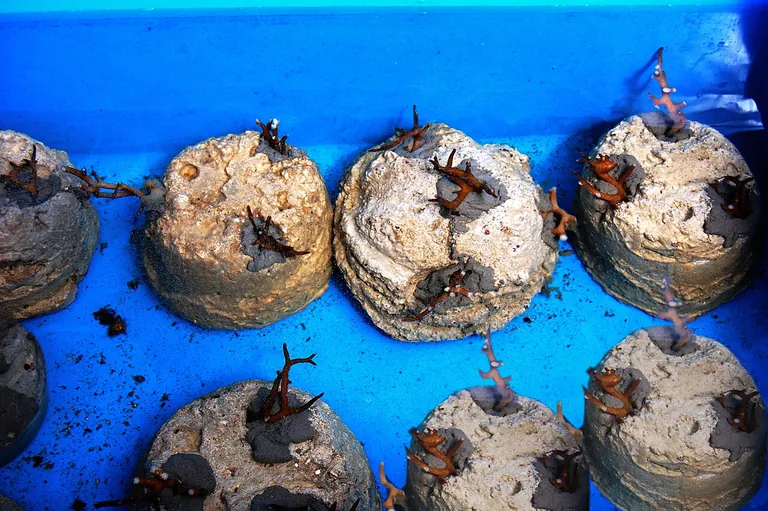
The 3D-printed EcoReefs artificial structures were deployed in the Bari Canyon (South Adriatic Sea) to support the ecological restoration of degraded cold-water coral (CWC) habitats. The main objectives were to enhance habitat structural complexity by providing stable hard substrate and promote the recruitment, growth, and long-term persistence of Madrepora oculata and Desmophyllum pertusum. The intervention aims to restore the physical habitat architecture and ecological functions characteristic of healthy CWC ecosystems.
- Paper
Performance Assessment of Posidonia oceanica (L.) Delile Restoration Experiment on Dead matte Twelve Years after Planting—Structural and Functional Meadow Features
- Case study
Seabed litter removal in the Bari Canyon
Within the LIFE DREAM project, an experimental activity to remove seabed litter physically impacting cold-water coral habitats was carried out during the ECOREST24 oceanographic campaign aboard the R/V Gaia Blu. A remotely operated vehicle (ROV) was used to identify and recover seabed macrolitter, including plastic bags, batteries and abandoned fishing nets, using robotic manipulators. Building on this and other experimental activities, the project aims to develop a technical protocol for marine litter removal and risk assessment.
- Case study
Artificial Reef Structures in the Dohrn Canyon (Gulf of Naples)
In 2024, 3D-printed EcoReefs artificial structures were deployed in the Dohrn Canyon (Tyrrhenian Sea) to support the ecological restoration of degraded cold-water coral (CWC) habitats. The structures aim to enhance habitat complexity by providing stable hard substrate and promote the recruitment, growth, and long-term persistence of Madrepora oculata and Desmophyllum pertusum, helping restore the physical structure and ecological functions of CWC ecosystems.